Myths and folktales from a nomadic culture that once inhabited the heath commons pose a challenge to the prevailing view of the heathland as an isolated and distinctively Danish culture. They highlight the cultural connections of the heathland, connections that extend beyond Denmark’s borders. This contribution probes the unacknowledged history of one of the many and various cultures that traditionally sustained the west Jutlandic heathlands – the “skøjere,” or, as they would also call themselves, “rejsende” or travellers. Through her artistic research and practice, which she roots in her own family history, Marie Kølbæk Iversen delves into the mythologies of these travellers to explore and empower a broader “we” – one that transcends the boundaries of a Danish and nationalistic narrative.
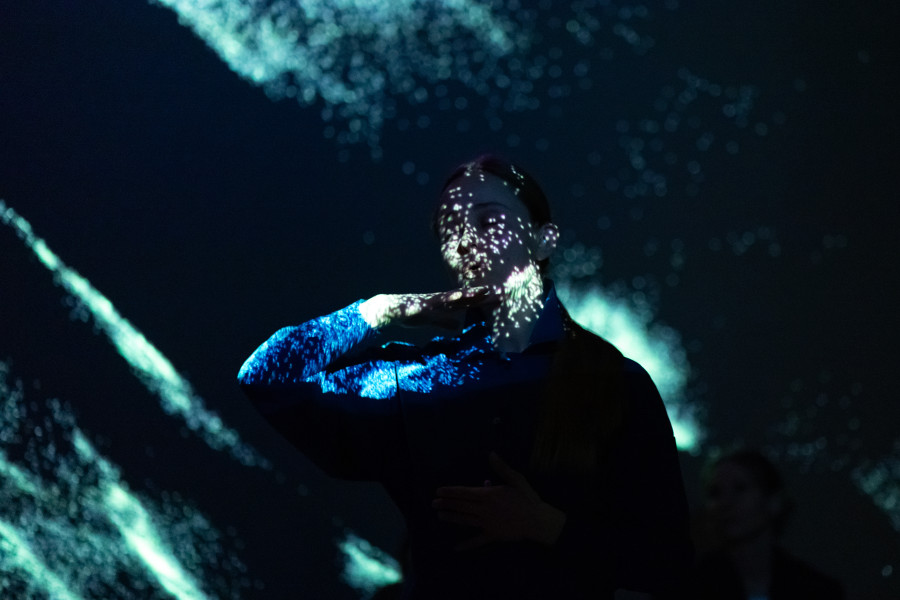
Marie Kølbæk Iversen, Donnimaar [performance] inside Marie Kølbæk Iversen, Rovhistorier | Histories of Predation [video installation] in “The Atlantic Ocean,” a group exhibition at Henie Onstad Art Centre, Høvikodden, Norway. (Photo: © Nabeeh Samaan and Henie Onstad Art Centre)
( Abstract )
Through the author’s artistic research, which engages with her own family history, this text probes the underacknowledged history of one of the plurality of different cultures that have traditionally sustained the west Jutlandic heathlands, namely the “skøjere,” or, as they would also call themselves, “rejsende” – that is, travellers. This group, which contributed to the heathlands’ social ecologies in multiple ways and operated across the heath between the remotely located heath farms, is not necessarily thought of as indigenous to the heathlands because they were not sedentary. But Iversen argues that we cannot account for the cultural specificities of the heath commons – or for the significance of their collapse in the modern era – without taking its travelling communities into account.
Introduction
I am a visual artist and art researcher hailing from Tjørring, a suburb of Herning, west Jutland, where I grew up in the 1980s and 1990s. My parents were always trying to draw my attention towards nature, but like many children, I was more interested in the devices of popular culture – the new, the shiny, the technologically advanced. Yet the flora and fauna on the local heathlands and the plantations to which they succeeded nonetheless in introducing me settled within me as my persistent idea and ideal of “Nature” – a synaesthetic concept comprising all the senses – which added to my growing sense of disjuncture as I came of age, because the reality I knew to be true with my senses did not match the official stories and explanations that I was told about my home country, Denmark.
Danish nature is represented by towering beech trees reflecting their image in mild seas and shallow sounds.
( 1 )
Oelsner 2021, 146–47.
But growing up in the west of Jutland, I knew beeches to be in the minority and the North Sea to be anything but mild. These were a child’s reflections on irreconcilable realities, but I found the same irreconcilables extended to my history school classes. Here we learned about the injustices and exploitations of premodern feudal society, from which a Danish “we” had been redeemed by the people’s struggle to achieve democracy in 1849, a prize won at the same time as the idea of a particularly Danish nature was being sublimated within the national romantic framework later known as the Danish Golden Age – the period that saw the beech naturalized as the homogenizing image of Danishness.
During the 1980s and 1990s, this Golden Age rendition of Danish history was dramatized across countless children’s TV shows, books, and films, exploring and expounding its particular view on Danishness as extending millennially across what were perceived as the few formative stages in national history: the so-called “Viking Age,” the era of absolute monarchy, and modernity.
( 2 )
For example the TV series Gøngehøvdingen (1992) and Matador (1978–1982), Lars-Henrik Olsen’s book series about Erik Menneskesøn (1986–2006), Peter Madsen’s film Valhalla (1986), and the comic book series Valhalla (1979–2009). In the present, however, the term “Viking” is becoming increasingly contested among researchers and historians, who argue that its original meaning in historical and archaeological sources was always “pirate,” and that a Viking people or age has never existed. Similarly, historians are problematizing the term’s persistent association with Nazi Germany’s idealization of a blonde warrior people, and some therefore argue that it should be labelled the “V-word” to emphasize the term’s relation to troubled and troubling pasts not worth perpetuating. Larsen et al., “Kampen om Historien: Farvel til Vikingetiden” (2023).
The vast majority of these productions were set in natural and architectural locations that looked nothing like my west Jutland surroundings. Which, to me, made official Denmark and its national mythical construct appear strangely phantasmagoric, fictional, and thus malleable.
On family car journeys with my parents to visit family and friends in other parts of the country, I was always astounded as a child to see the persistence of historical architecture and the remnants of feudal structuring in villages and cities. I recognized these from the fictionalized world of pop culture, as if a fantasy world of fairytale had suddenly come true before my eyes, complete with brutal overlords, crooked villains, innocent victims, and noble saviours. And likewise, when visiting us, eastern Danes seemed equally astounded by our lack of historical architectural enchantment: they joked, casually, about the ugliness of Herning in all its novelty – a stance so naturalized that in public media, Herning is often used as shorthand for tasteless liberalist consumerism. For example, in a column entitled “When liberalism smells like Herning” from 2013, the bourgeois-liberalist anthropologist and debater Dennis Nørmark called Herning both “inane” and “unhistoried” (my translations).
( 3 )
Nørmark 2013.
Later, after getting substantial criticism for the piece, Nørmark attempted to moderate some of his remarks in the radio programme Brinkmanns Briks. He conceded that, as a new city, Herning should be acknowledged for its pioneering spirit and constructive effort: “[T)here was truly nothing out there [on the heathlands] […] A hundred years ago there was nothing, except a few small huts with some shepherds,” he said (my translation and emphasis).
( 4 )
Brinkmann 2019 at 12:05–12:50.
Nørmark’s remarks were, obviously, condescending; but, paradoxically, they resonated with my childhood impression that the world and the place in which I was growing up did indeed amount to nothing at the level of cultural representation and national narrative. Not only had everything that existed before modernity – shepherds and sod huts – been violently erased with the enclosures of the heath commons from 1866, but those things in and of themselves did not qualify as “Culture with a capital C” worth safeguarding and preserving in their own right. This called my adult self back to the heathlands, where I found myself prompted to research and trace this supposed – or imposed – “nothingness” of preindustrial life and culture in the heathlands of west Jutland through my practice-based doctoral art studies at the Oslo National Academy of the Arts and Aarhus University between 2017 and 2022.
What follows draws and further expands upon my PhD dissertation, entitled “Neo-worlds: Transformative Agency through Fright, Rite, and Myth,” in which I attempt to outline the local historical context that led up to the structured political efforts to enclose and agriculturally develop the heath commons of central and west Jutland.
( 5 )
Kølbæk Iversen 2022, 39–55.
Focusing on folklore documented from members of my family by the folklorist Evald Tang Kristensen, and experimentally reading them “mythologically” in a Lévi-Straussian sense, I probe the cultural continuities that preceded Danish modernity on the heathlands.
( 6 )
According to Lévi-Strauss’ “mythologics,” it is possible to trace the historical developments of a culture or region by tracing its changing myths. He writes that mythic thinking can be characterized by functioning as a “shock absorber for the disturbances caused by real life events.” Thereby myths work to ensure cultural continuity against historical developments. Lévi-Strauss 1990 (1971), 607.
The underlying question is what emerges if, instead of taking “nothing” at face value, we instead understand it as a blind spot of majoritarian culture – as something which Denmark cannot contain or represent without compromising itself and its naturalized national narrative.
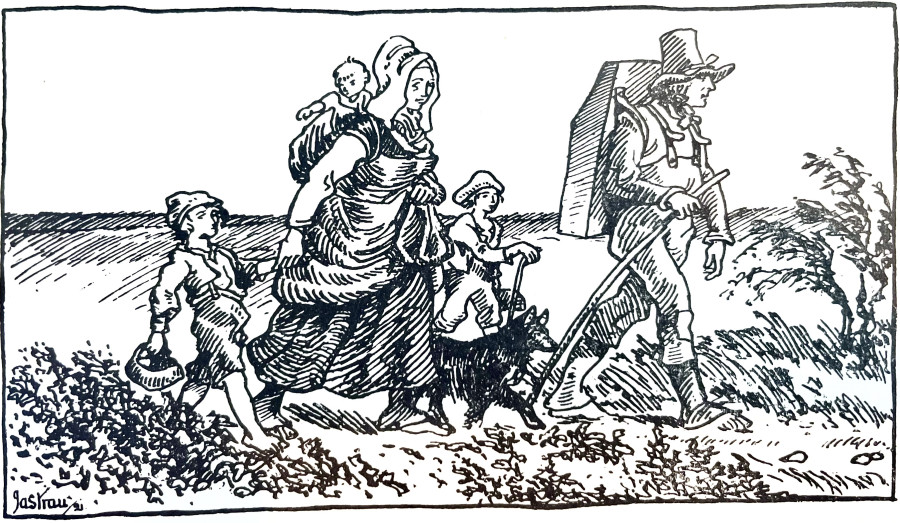
Travellers with children and dog on the West Jutlandic heathlands. Viggo Jastrau: Untitled, 1921, in H. P. Hansen: Natmændsfolk og Kjæltringer.
( 7 )
H. P. Hansen 1959, 9.
On Belonging and Unbelonging
While eastern Denmark – the Danish isles across the Kattegat and Baltic Seas, and the eastern parts of Jutland – was organized for centuries by a feudal structure, deep-time geological factors historically accounted for a very different lifestyle west of the Jutlandic ridge.
( 8 )
Løvschal 2022.
Since west Jutland was not covered by ice during the last ice age, its soils were not renewed or enriched by glacial minerals as in other parts of Denmark, and were thus unsuited to the intensive agriculture of the east Danish variant.
According to the archaeologist Mette Løvschal, the west Jutlandic sandy acidic soils instead provided for extensive pastoralist farming and shepherding across the heath commons.
( 9 )
Løvschal 2022.
Such extensive pastoralist farming, however, required large areas of land per farm, resulting in low population density.
( 10 )
Henningsen 1996, 50.
This meant that, in addition to sustaining themselves from a radically different kind of farming than their east Danish peers, the west Jutland heath farmers were generally also wealthier and more autonomous, being under little or no control of the authorities, as tax collection and law enforcement were difficult to carry out in these thinly populated, often adversarial regions.
( 11 )
The farmers easily outnumbered these representatives, who were often simply beaten up if they interfered with the heath dwellers. See Dengang vi var bønder: Hedebønder 2018 at 00:08:17 and 00:09:00.
This was something the Danish authorities were increasingly determined to change after the territorial losses of 1814 (Norway) and 1864 (Schleswig-Holstein), as part of the Danish national liberalists’ efforts to craft and consolidate the democratic Danish nation-state.
( 12 )
Henningsen 1996, 48.
In west Jutland, the national liberalist movement found one of its most ardent proponents in the priest and poet Steen Steensen Blicher (1782–1848), whose literary work has grown synonymous with the heathlands: its landscapes, peoples, customs, dialects.
( 13 )
Throughout the Jutland heath regions, places and buildings are named after Steen Steensen Blicher and Enrico Dalgas, the founder of the Danish Heath Society. As a child in Tjørring/Herning growing up in the 1980s, I attended a kindergarten called Steen Blicher’s Børnehave, and my best friend lived on Dalgasgade.
Blicher dedicated much of his prose to the particularities of the heathlands and their dwellers. He even on occasion wrote in dialect to mediate and document the different Jutlandic tongues to his pan-Danish readership.
( 14 )
Blicher 2012.
Yet Blicher’s political writings of the 1810s, 1820s and 1830s focus more on superseding such disparities than maintaining them to facilitate the country’s unifying homogenization. In his view, Danish homogenization required the accomplishment of three goals. The first was the marginalization of foreigners, such as (according to Blicher) Jewish people, by excluding them from political affairs and matters of the state.
( 15 )
“I know of no Country where They have enjoyed more Privileges than in Denmark (…) After having achieved such high degrees of Freedom, which neither they nor their Ancestors have known, (…) they become immediately desperate, because they are not allowed to become Deputies of the Estates, (…) because they cannot participate in the control of a foreign state! I say foreign[.]” (my translations). See newspaper articles by Steen Steensen Blicher: “Bør Jøderne taales i staten?” (1813), “Mosaiterne som Stænder-Deputerede” (1838), and “Ikke saa meget til B. R. og Syskind som om dem til Publikum” (1839) collected in Blicher 1984, 67.
The second was the establishment of disciplinary Magdalene asylum institutions, following the English example, to “save” fallen women and assert bourgeois Christian family values in society.
( 16 )
Steen Steensen Blicher, “Forslag til Redningshuse for faldne Piger?” (1815) “Endnu en Mindelse om Redningsanstalter for faldne Piger” (1827) and “Engang Endnu” (1828) collected in Blicher 1984, 91–100, 103–9, and 111–12.
The third and final prerequisite was the annihilation of aberrant cultural and linguistic traits within the Danish nation, such as those embodied and expressed by the west Jutland so-called “kjeltrings.” This community, largely unknown today, was a very concrete worry among Danish policymakers of the nineteenth century owing to their dissident culture and their unwillingness to assimilate with the sedentary Christian lifestyle prescribed by the nation-state.
( 17 )
“These were from old Age a deeply despised and debased Class of Humans. Of their Origins nothing is certain. I consider it most likely that they derive from our Heathen Ancestors’ Slaves”; “With which Eyes will they consider themselves? How may he find that self-esteem, which is a Source of Virtue as well as its Defence? Slave conditions – Slave mind!” “Subdued neither by Force, Work, or Worries of Sustenance, this Race is now breeding immensely; since these people obey solely the Command of Nature,” and “I see no more Efficient Means (…) than the complete Elimination of the Estate and its Name (…) and complete absorption into the other Civil Classes.” (my translations). See: “Om Natmændsfolkene” (1820) in Blicher 1984: 115, 116, 117, 122; and “Ældre opfattelse af natmandsfolket og dets afstamning” in H. P. Hansen 1959, Natmændsfolk og kjæltringer, 10.
The word “kjeltring” is a slur that today, as then, translates into something like “crook.” As an exonym, it was used by the Danish authorities to define a heterogenous group of people, some – but not all – of whom called themselves “rejsende” (travellers) or “skøjere.” And some – but not all – of whom worked as nightmen or knackers.
( 18 )
The kjeltrings were far from a unified class, Tang Kristensen writes: “Once, a Kjeltring Woman came to Niels Halds’ Farm in Breum to beg, while the others were waiting outside. His Wife had gone to Church, and he did not know what to give her, or how to get rid of her. Then he got the idea that he may be able to get rid of them by asking if they could skin a male Dog for him. ‘No, No,’ they responded, ‘we may be Kjeltrings, but we are still not Knackers.’ Much lies in this answer” (my translation). See: “Småtræk af Kjæltringernes Liv” in Tang Kristensen 1888. See also “Kjeltringliv” in Blicher 1984, 131, and “‘Kjæltringer’ som fællesbetegnelse til tiggere af natmandstypen” in H. P. Hansen 1959, 57.
In what follows I will be using the term “kjeltring” only in direct quotation. When referring to members of the travelling community, I will henceforth use the term “travellers,” since according to both Blicher and Jutlandic historian H. P. Hansen, this was what most preferred to call themselves.
( 19 )
“The real Kjeltrings – not those crooks you find distributed across the other ranks and classes – form an isolated unity, a state within the state; which is why a Frenchman passing through was more right than he would ever know when observing that ‘en Dannemarc il y a une nation qui s’appelle Kjeltrings, elle n’est pas si bien cultivée comme les autres danois.’ – This nation calls itself travellers” (my translation). See “Kjeltringliv” in Blicher 1984, 131, and “Ældre opfattelse af natmandsfolket og dets afstamning” in H. P. Hansen 1959, 9. To avoid confusion with present-day travelling communities, such as the Irish Travellers, I refrain from writing “traveller” with a capital T.
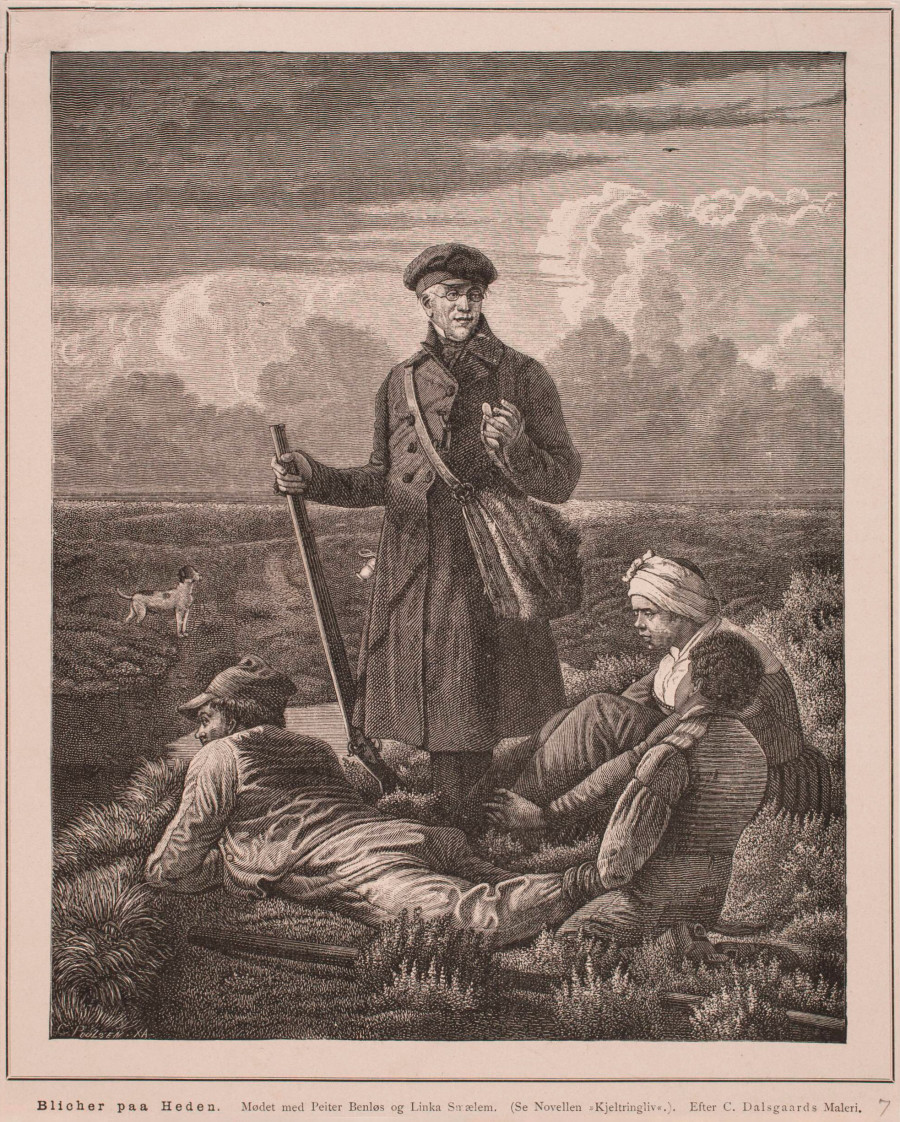
Steen Steensen Blicher with his fictional travelling couple Linka Smælem and Peiter Beenløs. Carl Poulsen, after painting by Christen Dalsgaard, Blicher paa Heden, date unknown (1855–1935). Xylography. SMK – National Gallery of Denmark, KKS 12109, SMK OPEN: https://open.smk.dk/artwork/image/KKS12109?q=historie&page=1 (accessed November 8, 2024). (Photo: © SMK – National Gallery of Denmark.)
Crooked Life
While much of Blicher’s prose and poetry concerning Jutland appears to be a homage to the peninsula and its inhabitants, his political writings cast the latter in a different and less empathic light. For example, his romanticizing and exoticizing portrayal of the fictional travelling couple Linka Smælem and Peiter Beenløs in the 1829 short story “Kjeltringliv” (Kjeltring Life, or, pejoratively, Crooked Life/Life as a Crook) did not keep him from formulating a detailed programme for the elimination of the travellers in a newspaper article published in 1820.
( 20 )
“Blicher’s ‘Linka Smælem’ only carries the exotic traits, which the writer’s vigorous fantasy (…) has attributed to her. That the name is an invention of Blicher is indisputable. Linka’s name was Birgitte, and Peiter was called Mikkel.” And “[D]espite his lively interest and fair knowledge of these nature peoples, [Blicher…] is blind to the fact that these are – ethnographically regarded – good Danes [sic.].” (my translations). See H. P. Hansen, “Afstamning – typer – personnavne” in Hansen 1959, 80 and 89; and “Om Natmændsfolkene” and “Kjeltringliv” in Blicher 1984, 115–26 and 129–52.
Interestingly, the article preceded the short story by nine years, suggesting that Blicher’s romanticizing view was at the same time a “deadening gaze” akin to that of the hunter who revels in the physiognomic and behavioural particularities of his game while plotting to kill it.
“Kjeltringliv” supposedly draws on Blicher’s own experiences from 1817, when during a thunderstorm he became the accidental witness to a kjeltring dance or “ball” in the Axelhus, a small house that had been erected on Ørre Heath in 1816 by the Poor Law authorities to confine the infamous traveller Johannes Axelsen and his family. Even if later revealed as pure fiction, this story – in all its exoticizing spectacularity – became instrumental in forming the national Danish conception of this “state within the state” of peoples variously designated as “kjeltringer,” “natmænd,” “skøjere,” “rakkere,” or “tatere,” grouping these presumably distinct but in many ways also overlapping travelling groups into one less-than-human savage entity for the Danish authorities to antagonize and confront.
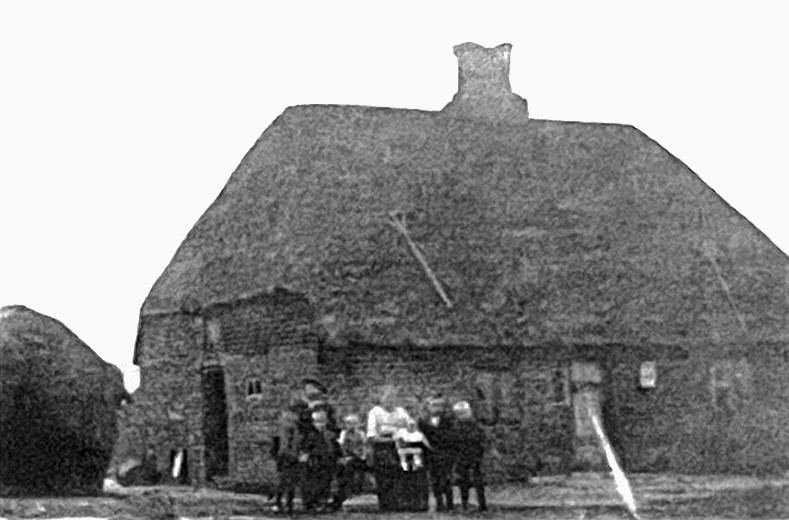
Axelhus in Sammelsted By. Built in 1816. Moved and rebuilt in 1892 with materials recycled from the original Axelhus. Archival photo of the second Axelhus from onsite information poster in “Helenes Hus,” Herning Municipality. (Photo: © Herning Municipality.)
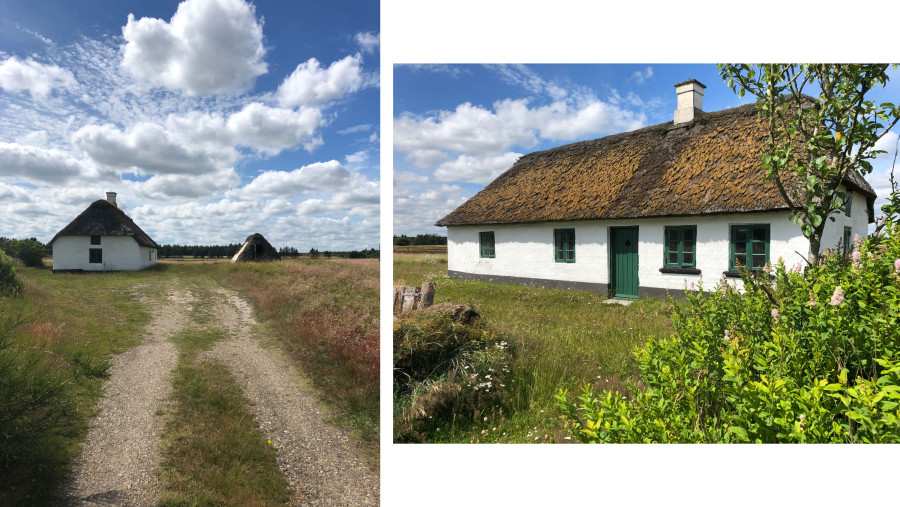
38 years after the hounding of the travellers (kæltringejagten), Sammelsted By was home to my great-great-great-great-grandmother Johanne Tygesdatter, when she was approached by the Danish folklore collector Evald Tang Kristensen in 1873. Along with Axelhus, Johanne’s house was one of the six houses in 1834 constituting the settlement. The house still stands today and is designated “Helenes Hus” (‘Helene’s House’) after its last inhabitant. It is the only remaining building of Sammelsted By and functions as a < 30 m2 mini-museum under Herning Municipality to shed light on the history of the travellers and the authorities’ harsh disciplinary measures against them. (Photos: © Marie Kølbæk Iversen, 2021.)
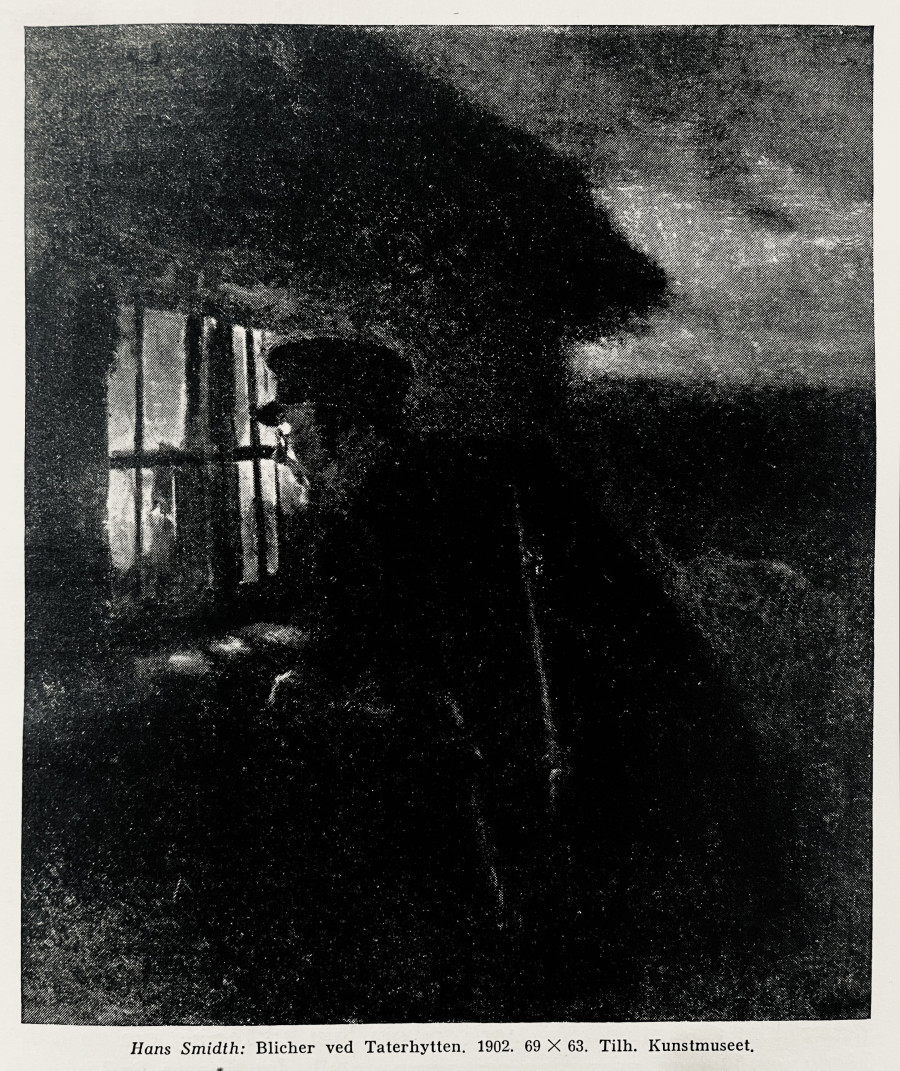
Blicher supposedly witnessing the “kjeltring ball” (kjæltringbal) when peeking through the window of Axelhus, here referred to as “Taterhytten.” “Tater” was another derogatory exonym assigned to the travellers. Reproduction of Hans Smidth, Blicher ved Taterhytten, 1902. Oil on canvas, 69 x 63 cm. SMK – National Gallery of Denmark.
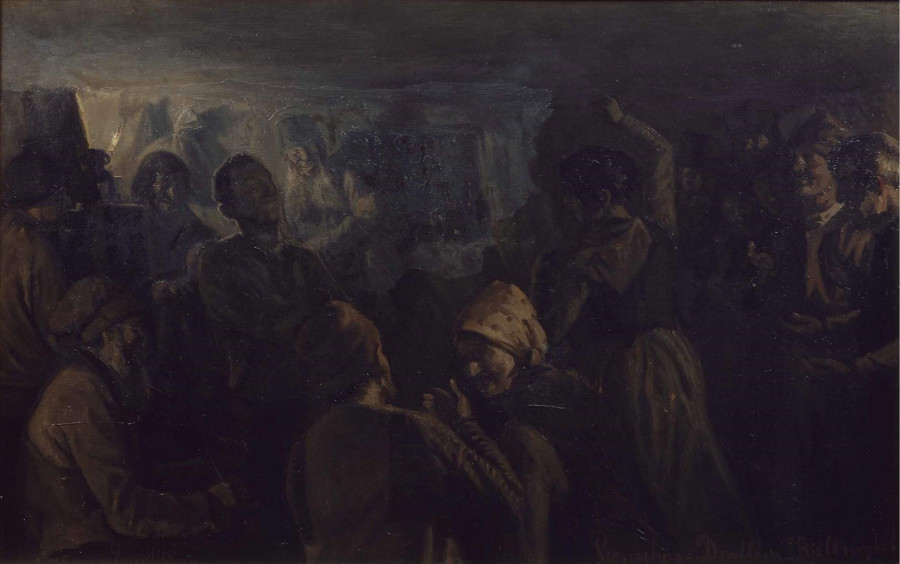
The “kjeltring ball” (kjæltringbal) that Blicher claimed to have witnessed on Ørre Heath. Hans Smidth, Pennekas Drallers Kjeltringbal, 1894. Oil on canvas, 61.3 x 96.5 cm. The Hirschsprung Collection, Copenhagen, inv. no. 479. (Photo: © The Hirschsprung Collection.)
The pursuit of eugenics had not yet been brought into disrepute by the fascisms and genocides of the succeeding century, and Blicher was not the only intellectual of a national liberalist bent who was fantasizing at this time about ways to refine and eventually assimilate what he considered a less than fully human race. “To take the Children from their Parents is in Fact an Act of Kindness,” he writes of the travellers:
[P]articularly with regard to the Former; as this may know very little of this crude and for almost all tender Feelings deprived Human Race, and would not know: That the most one might in general expect is only an instinctual Care from the Mother towards her child, as long as she is suckling the infant by her breast. (…) For the Unborn, a Door would be opened to a comprehensive Refinement, by the eradication of the Past’s imprinted Stigma” (my translation). ( 21 )
“Om Natmændsfolkene,” in Blicher 1984, 125–26.
Using the word “natmand” (nightman) interchangeably with “kjeltring” in his 1820 article “On the Nightman People,” Blicher expounds his views on how to discipline the travelling people, emphasizing that what is required is nothing short of the “Complete Elimination of the Estate and the Name”:
( 22 )
In this text, Blicher primarily uses the word “nightman” (natmand), but the words “rakker” and “kjæltring” (both p. 122) also find their way into the text, indicating to me that he is taking aim at the same heterogenous group of people as in the short story “Kjeltringliv.” Exonyms for the kjeltrings include “kjeltring,” “natmand” (nightman), “skøjer,” “rakker” (knacker), “tater” (gypsy), and “rejsende” (traveller), among others. See: Blicher 1984,115–26 (my translations and paraphrases).
- On a secret date, known only to the district and the city bailiffs, all Nightmen – sedentary as well as nomadic – are to be arrested and taken to the nearest market town, where food and shelter has secretly been prepared for them beforehand.
( 23 )
Blicher 1984, 123. - Here the arrested mass is examined: escaped prisoners are to be handed over to their assigned places; foreign vagabonds are to be escorted out of the country; all domestic beggars and vagrants that are not of Nightmen kin are to be handed over to the Poor Law Authorities for further treatment.
( 24 )
Blicher 1984, 123. - From the remaining proper Nightmen people, the old, disabled, and sickly are to be sorted out and handed over to hospitals and poorhouses for their lifetime maintenance.
( 25 )
Blicher 1984, 123. - Further, all children aged 7 to 15 are to be brought to orphanages, or have their upbringing and training provided for in another way by the government in the skills of either carpentry, handicrafts, or maybe – for the boys concerned – military service. The outmost efforts must be made that their origins are forgotten, and therefore they should eventually be placed where this may indeed happen, such as in Copenhagen or the Danish colonies abroad.
( 26 )
Blicher 1984, 123–24. - For the remaining Nightmen, two colonies are to be built on two uninhabited islands – e.g. Hesselø and Hjelm – one for able-bodied legally married couples as well as illegally married couples with children below the age of seven. The other island is for able-bodied unmarried couples, and illegally married couples who do not have children below the age of 7.
( 27 )
Blicher 1984, 124.- In the first colony for families and/or married couples, each family is to be assigned a plot of land to which they may tend when not working in the factory, which is to be set up on the island. The factory is overseen by a factory manager and the whole island by an inspector. No school is needed on the island since the children who may be born will be brought – between the age of 6 or 7 – to the above-mentioned orphanages. Neighbouring priests will take turns conducting service on the island, and a military unit will be deployed to secure order and prevent the colonists from deserting.
( 28 )
Blicher 1984, 124. - The second colony is very much like the first one, only here men and women are kept apart in different buildings. Marriages are allowed, but in that case the couple will be relocated to the former island. Within 40 to 50 years, all colonists will likely be dead and the intention with the operation thus met.
( 29 )
Blicher 1984, 124. (my translations and paraphrases).
- In the first colony for families and/or married couples, each family is to be assigned a plot of land to which they may tend when not working in the factory, which is to be set up on the island. The factory is overseen by a factory manager and the whole island by an inspector. No school is needed on the island since the children who may be born will be brought – between the age of 6 or 7 – to the above-mentioned orphanages. Neighbouring priests will take turns conducting service on the island, and a military unit will be deployed to secure order and prevent the colonists from deserting.
( 28 )
Blicher published his proposal in 1820. Fifteen years later, on 11 February 1835, the local authorities of Ringkjøbing, Viborg, Aalborg, and Randers launched a large-scale hounding of travellers within the territories of their jurisdiction.
( 30 )
“Kjæltringejagten i jyske amter” in H. P. Hansen 1966, 57.
Although no one from traveller strongholds such as Dejbjerg or Rind was apprehended, Jutlandic historian H. P. Hansen still considers the outcome impressive, not least taking into consideration the vastness of the terrain and the limited number and mobility of the search parties:
( 31 )
H. P. Hansen 1966, 57.
64 were caught in Ringkjøbing county, 45 in Viborg county, and 33 in Aalborg county.
In total, 142 people were detained, of whom 24 were below the age of 15.
( 32 )
H. P. Hansen 1966, 57.
These were arrested and convicted of vagrancy. Regardless of their age, those who had not previously been so were forcibly baptized and/or confirmed. Illegally cohabiting couples were married, able-bodied men and women were distributed among the peasants as labour force, and children assigned mandatory schooling.
( 33 )
H. P. Hansen 1966, 57–58.
Many children were likely also removed from their parents, to be “out-sourced” (literally, udliciteret) to live with and work for the peasants. This was common practice with regard to the children of the travellers.
( 34 )
The Poor Law authorities “outsourced” the daughters of Johannes Axelsen, of whom the youngest was aged nine. The children were henceforth banned from seeing their mother. “Yet the mother kept visiting the girls, and the girls kept running home to their mother, which meant that the Poor Law Authorities had to remove them time and again.” Helenes Hus, Herning Municipality, onsite information poster (last visited March 2022).
Those without permanent residence were however not sent to the colonies, as Blicher had proposed, but to poorhouse facilities such as Axelhus, the house erected for Johannes Axelsen in Sammelsted By on Ørre Heath, as described by Blicher in “Kjeltringliv.”
Lost Without, Lost Within
H. P. Hansen, in turn, attempted in his own book of 1921, Natmandsfolk og kjæltringer, to shed light on the travellers of west Jutland, who – in addition to being largely nomadic – spoke their own language, known among other names as “Prævelikvant”. This was a creolization of Jutlandic intermixed with words of their own and words deriving from other travelling peoples.
( 35 )
E.g., the German Rotwelsch, Central European Yenish, and the Norwegian Fant language, Rodi. See: H. P. Hansen, “Kjæltringsproget” and “Sköjersproget” in Natmændsfolk og kjæltringer (Hansen 1959), 89–100 and 100–113); Bo Hazell, Resandefolket: Från Tattare til Traveller (Hazell 2011, 14); and Christian Bader, “Lieux et itineraires: La diaspora yéniche: Voyageurs de Scandinavie” in Yéniches: Les derniers nomads d’Europe (Bader 2007, 100–102).
Prævelikvant translates into something like “the beautiful language”: præwweler meaning “to talk,” and kwandt meaning “good” or “beautiful.”
( 36 )
H. P. Hansen 1959, 106 and 108.
Speaking prævelikvant – speaking beautifully and well – enabled the travellers to have a conversation in public without being understood. Rumour had it that members of the travelling community were not allowed to reveal their language to outsiders, and that the consequence of doing so was severe retribution, possibly even death, something that Hansen was however unable either to confirm or deny.
( 37 )
H. P. Hansen 1959, 98–100.
Attempting to trace the diffuse origins of the Jutlandic travellers, Hansen writes that they were first described as a unified class in 1699 by Otto Sperlingius.
( 38 )
“Ældre opfattelse af natmændsfolket og dets afstamning” in H. P. Hansen 1959, 9.
He believed them to be the descendants of:
[…] the country’s first indigenous population, the Celts; a conception shared by E. Pontoppidan in his “Danske Atlas” until 1763, when the author, after having mentioned the immigration of the Æsir, writes: “Those who (…) did not want to appropriate the new oriental Life Style, but maintained the old Dress and simple Customs, either had to escape to deserted Places, or be treated with extreme Disdain by the proud Æsir, who marginalized them by the name of Keltringer, which is still used today to designate the most debased and horny of Peoples” (my translation; Hansen’s emphasis). ( 39 )
Erik Pontoppidan, Danske Atlas, 31, quoted in H. P. Hansen 1959, 9–10.
Hansen’s coupling of Sperlingius’s and Pontoppidan’s writings concerning the travellers encapsulates the breadth and confusion of their changing conceptions: indigenous nomads, Celtic descendants, lowlife crooks, nightmen, beggars, knackers...
Hansen, however, regards their ethnic cohesion and their alienation from the surrounding society as a figment of their various beholders’ lively imaginations. In this respect he refutes Blicher’s assumption that the Jutlandic travellers were a distinct race: Hansen’s own experience from growing up on the heathlands at the turn of the nineteenth and twentieth century, as well as his later ethnographic and ethnological work, showed that “these people, ethnographically regarded, were no different from the rest of the population” (my translation).
( 40 )
“Afstamning – typer – personnavne” in H. P. Hansen 1959, 79.
However, for Hansen this did not change the fact that, just as the heath farmers’ lifestyle had diverged substantially from that of their east Danish peers, the lifestyle of the travellers had diverged substantially from that of the sedentary heath farmers, in spite of their intertwining ancestries and shared dependence on the heath commons.
To accentuate the interconnectedness between these two different groups of heath dwellers, the folklorist Evald Tang Kristensen had in his 1888 book Småtræk af Kjæltringernes Liv emphasized “the intricate connection which tied the Life of the Kjeltrings to the Life of the lower Peasantry at the Time given,” and stated that “the one only with the other might serve to complete the Picture of ‘poor Peasants’ Life at the Time’” (my translation).
( 41 )
Tang Kristensen 1888.
Because, as previously described, since the heathlands’ sandy soils traditionally provided for only a few farms, the surplus population had to support themselves in other ways. Many emigrated, but quite a few also took up life as wandering service providers, becoming enrolled in or associated with the “travelling estate” to sustain themselves as glaziers, messengers, chimney sweepers, making and soldering tinware, knitting and spinning, skinning dead animal carcasses, and as wise men and women or healers, among other occupations.
( 42 )
Regarding emigration, see: “Det mørke Jylland” (Henningsen 1996, 50). Regarding wandering service providers, see: Mylius Erichsen, Den jydske Hede (Erichsen 1903, 435–516), quoted in: “Ældre opfattelse af natmændsfolket og dets afstamning” (H. P. Hansen 1959, 17). Regarding glaziers, see: “Ærlig – uærlig: Glarmesterfolk” (H. P. Hansen 1959, 56–57). Regarding messengers, see: “‘Kjæltringer’ som fællesbetegnelse for tiggere af natmandstypen” (H. P. Hansen 1959, 62). Regarding chimney sweepers, see: “Ældre opfattelse af natmændsfolket og dets afstamning” (H. P. Hansen 1959, 16). Regarding tinware production and soldering, see: “Ældre opfattelse af natmændsfolket og dets afstamning” (H. P. Hansen 1959, 10–11). Regarding knitting and spinning, see: “‘Kjæltringer’ som fællesbetegnelse for tiggere af natmandstypen” (H. P. Hansen 1959, 63–64). Regarding knacker work (skinning the carcasses of dead animals), see: “Ærlig – uærlig: Glarmesterfolk” (H. P. Hansen 1959, 56–57). Regarding wise men and women, see: “Laust Glavind: Glavinds Familieforhold” in H. P. Hansen, Kloge Folk: Folkemedicin og Overtro i Vestjylland I (H. P. Hansen 1942, 65).
Travellers were also known to be skilled fishermen and hunters, working with premodern implements across the commons and selling the part of the catch they did not need to sustain themselves.
( 43 )
“‘Kjæltringer’ som fællesbetegnelse for tiggere af natmandstypen” in H. P. Hansen 1959, 57–58.
This however changed with the Danish state’s homogenization and Danification efforts after 1814, which resulted in a targeted programme to discipline travelling communities by seeking them out and clamping down hard on their vagabonding, to force their assimilation into the general peasantry.
( 44 )
“Ældre opfattelse af natmændsfolket og dets afstamning” in H. P. Hansen 1959, 10.
Seeing their legal sources of income dwindle as a result of these efforts,
( 45 )
Evald Tang Kristensen: “Småtræk af Kjæltringernes Liv” (1888).
many travellers increasingly turned to begging and stealing for their survival, which further informed their stigmatization and persistent reputation as crooks and lowlifes.
( 46 )
“‘Kjæltringer’ som fællesbetegnelse for tiggere af natmandstypen” in H. P. Hansen 1959, 57.
To challenge the way they have thus entered posterity, I would like to offer two anecdotes that in my view attest to the travellers’ life and society as something more – and other – than merely poor and crooked.
The first anecdote is drawn from Hansen’s major work of 1921, Natmændsfolk og kjæltringer. It concerns a travellers’ wedding to which the seamstress Jette Skak was invited in 1874 as the only outsider, having sown the black damask gown for the bride (who Hansen calls “Kjæltring Katrin”). The wedding was held in a small sod-thatched house on Skærlund Heath. Pots and pans had been borrowed in Skærlund, and each guest contributed to the feast by bringing food, forks, knives, and spoons. “The bride was beautiful,” Skak tells Hansen:
[S]he was wearing a long pale-red bridal veil instead of the short white ones that were used at the time. And in her myrtle crown, seven white fabric flowers were placed. When people had finished eating, the tables were moved aside, and Jette thought they were going to dance. But instead, the father took hold of the bride’s left hand and stepped into the middle of the floor, while the two mothers moved aside. Immediately all the others, with the exception of the groom, circled tightly around father and daughter. And now the groom had to struggle in order to break the circle and get through to his wife. He took off his coat and toiled greatly, and finally he succeeded in picking out a small girl, making his way into the circle, and securing his bride in his arms. The father let go of her, and immediately the groom’s father stepped forth, shook the young couple’s hands and wished them happiness and blessings, upon which everyone fell on their knees, covered their faces in their hands, and mumbled some kind of prayer. (…) During the ceremony in the living room, many were crying (my translation). ( 47 )
“Ægteskab – moral – religion” in H. P. Hansen 1959, 68–69.
After the ceremony in the house, the couple and the two fathers went to church to receive the priest’s blessing, while the guests prepared the house for the subsequent party. The intricacy of the ceremony, and the solemnity with which it was carried out, stand in marked opposition to the general preconceptions about the travellers’ intimate life. Such preconceptions held that:
[t]heir Indecency surpasses all Description. (…) For Education in Christianity, Confirmation, and Communion, they care not the slightest. (…) Polygamy, Incest, Adultery, Drunkenness, Theft, Robbery, are all common iniquities of theirs. Their Wedding Ceremonies are short; if they meet somewhere, they throw their Staffs against each other (…), that is, they swap Beggar Staffs, and now the Union lasts until one of them finds a better Match (my translation). ( 48 )
Fyens Stifts Adresse Avis, no. 100 (1815), quoted in: “Ægteskab – moral – religion” in H. P. Hansen 1959, 68–69.
That the travellers’ marital and sexual norms differed from those of the sedentary population seems indisputable, however; both sexes had relative freedom to be with, or change, their partners as they liked.
( 49 )
H. P. Hansen 1959, 67.
Yet, as the first anecdote suggests, that these people were poor in material terms did not mean they had no culture.
The second anecdote, which I believe poses a counter-image to the prejudicial stereotyping of the Jutlandic travellers as lowlife crooks, is recounted by Evald Tang Kristensen, who writes in 1888 that according to his older informants, the travellers used to be quite wealthy.
( 50 )
Tang Kristensen 1888.
For example, the traveller Per Lind’s children were known to be more than properly dressed. Once, when he and his family stopped over at a farm, the farmer’s children had persuaded Lind’s children to show them their clothes and accessories, among which were a handful of
incredibly pretty dresses, sown in [traveller] style with Adornments and red Ribbons and in the same Fashion as the other Children’s, namely with short Sleeves. One of the Farmer’s Daughters tried on one of these Dresses and liked it so much that she later asked her mother to give her a Dress like Per Lind’s Daughters’. But she was scolded instead[, writes Tang Kristensen; my translation]. ( 51 )
Tang Kristensen here writes “rakker” (knacker), but I translate it to the word traveller because this, unlike knacker, is not affiliated with the profession of skinning the carcasses of dead animals, which I believe is not necessarily what is referred to here. See: Tang Kristensen 1888.
The farmer’s daughter is scolded for her wish to look like the traveller girl, even if the latter’s dress is described as beautiful, fashionable, and well-made. The same mix of exoticizing reverence and disdain for the travellers is reflected in the accounts given by the fiddler Pe’ Spælmand – Peder Jensen (1898–1986) – who in his early years received training from the old fiddler Kræn Lillevrå, or Christen Jensen, of whom it was said that
he had practically been raised among the Kjeltrings on the heath. (…) Among other things, it was said of Kjeltrings that they were highly skilled musicians. When they threw balls in their small houses, they could make new melodies offhand, which would be named after an incident related to the ball (my translation). ( 52 )
Kræn Lillevrå, who is referred to in the book, is likely my great-great-grandfather Christen Jensen (1848–1925). The authors write that the old fiddler was named Lillevrå after the name of his smallholding, Lille Vrå, but they seem to have confused him with another Christen Jensen (1834–1917), who was born in Over/Øvre Vrå, but also lived and died in the parish of Vrå, like my great-great-grandfather. On the basis of parish records, the authors attempt to provide the age and date of death of Pe’ Spælmand’s mentor, Kræn Lillevrå, but those stated are of the other Christen, even if it was my great-great-grandfather who was born, lived in – and was named after – the Lille Vrå smallholding. My great-great-grandfather Christen Jensen worked and taught as a fiddler his entire life and was raised on the heath. I therefore consider it likely that the authors simply singled out the wrong Christen Jensen when flipping through the Vrå parish records. See: “Peder Spillemand, Pe’ Spælmand” in Hviid et al., Hjejlens Toner. Peder Spillemand. En vestjysk spillemand. Menneske, musik og miljø (1991), 37–38).
Kræn Lillevrå taught Pe’ Spælmand many of the travellers’ scores, which differed from the mainstream fiddle music of the time in their staccato style. The old fiddler often also played at the travellers’ dances or “balls” in Sammelsted By on Ørre Heath. On one such occasion, Pe’ Spælmand was invited to come along, but he declined: “A tø’t det war under mi værdihed” (I thought it was beneath my dignity), he explained.
( 53 )
According to Pe’ Spælmand, Sammelsted By was also called “Lille Kjøvenhavn” (Little Copenhagen). My great-great-great-great-grandmother Johanne Tygesdatter’s house – later known as “Helenes Hus” – was located in Sammelsted By. See Hviid et al. 1991, 37 and 131.
The Transformation
Evald Tang Kristensen’s fieldwork in the 1870s, 1880s and 1890s was initially sparked by the national romantic desire to record Denmark’s ancestral mythical heritage where it was thought to still be preserved, namely among the rural populations of west and central Jutland.
( 54 )
Evald Tang Kristensen, “Efterskrift” in Gamle Jyske Folkeviser, samlede af Folkemunde, især i Hammerum Herred (Tang Kristensen 1876, 317–19).
Tang Kristensen imagined himself in a race against time to save the country’s folklore before it was lost, once and for all, to the forces of industrialization and modernization. These, by the 1860s, had made their own entrance on the heathlands.
( 55 )
Dengang vi var bønder: Hedebønder (2018) at 00:17:33.
In 1866, partly in response to the 1864 loss of Schleswig-Holstein, Enrico Dalgas and the Danish Heath Society had launched their sweeping agricultural development project to cultivate the heath, once and for all. This effort became inextricably linked with the words of the poet H. P. Holst that “what is lost without, must be won within” (my translation). The endeavour was presented to the local inhabitants as a “help to self-help” scheme, reminiscent of present-day development aid to so-called “underdeveloped” countries.
( 56 )
Jan Baltzersen: “National genrejsning efter nederlaget i 1864” (2005), and Dengang vi var bønder: Hedebønder (2018) at 00:18:00.
Despite the optimism and good intentions underlying these efforts at cultivation, however, the process ended up marginalizing and impoverishing many of the local inhabitants, who lost access to the pastoral commons and social networks they had relied on for their living, and were equally unable to sustain themselves from the small plot of sandy land they were assigned through the land reforms.
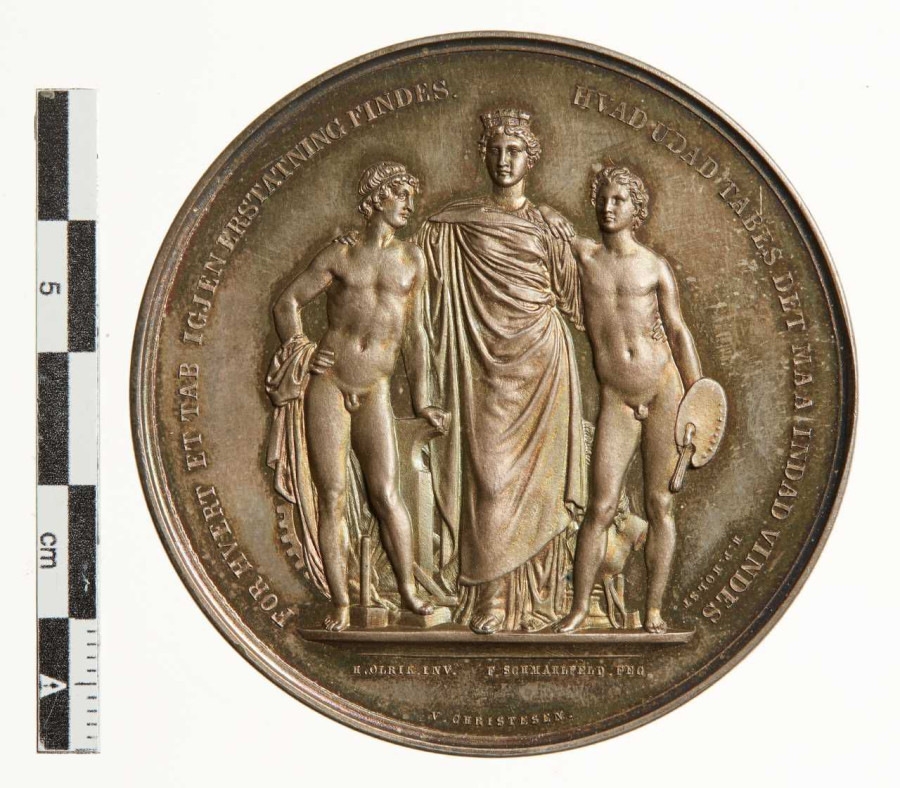
Silver medal issued on the occasion of the Nordic Industry and Art Exhibition in 1872. The medal features the famous quote by poet H. P. Holst: “For every loss replacement will be found. What’s lost without must within be won,” (my translation from the Danish). Silver, 63.15 g. National Museum of Denmark, Royal Collection of Coins and Medals, obj. no. RP 1111.1: https://samlinger.natmus.dk/kmm/object/440644 (accessed November 8, 2024). (Photo: © Niels Jakob Elsborg Andersen and National Museum of Denmark.)
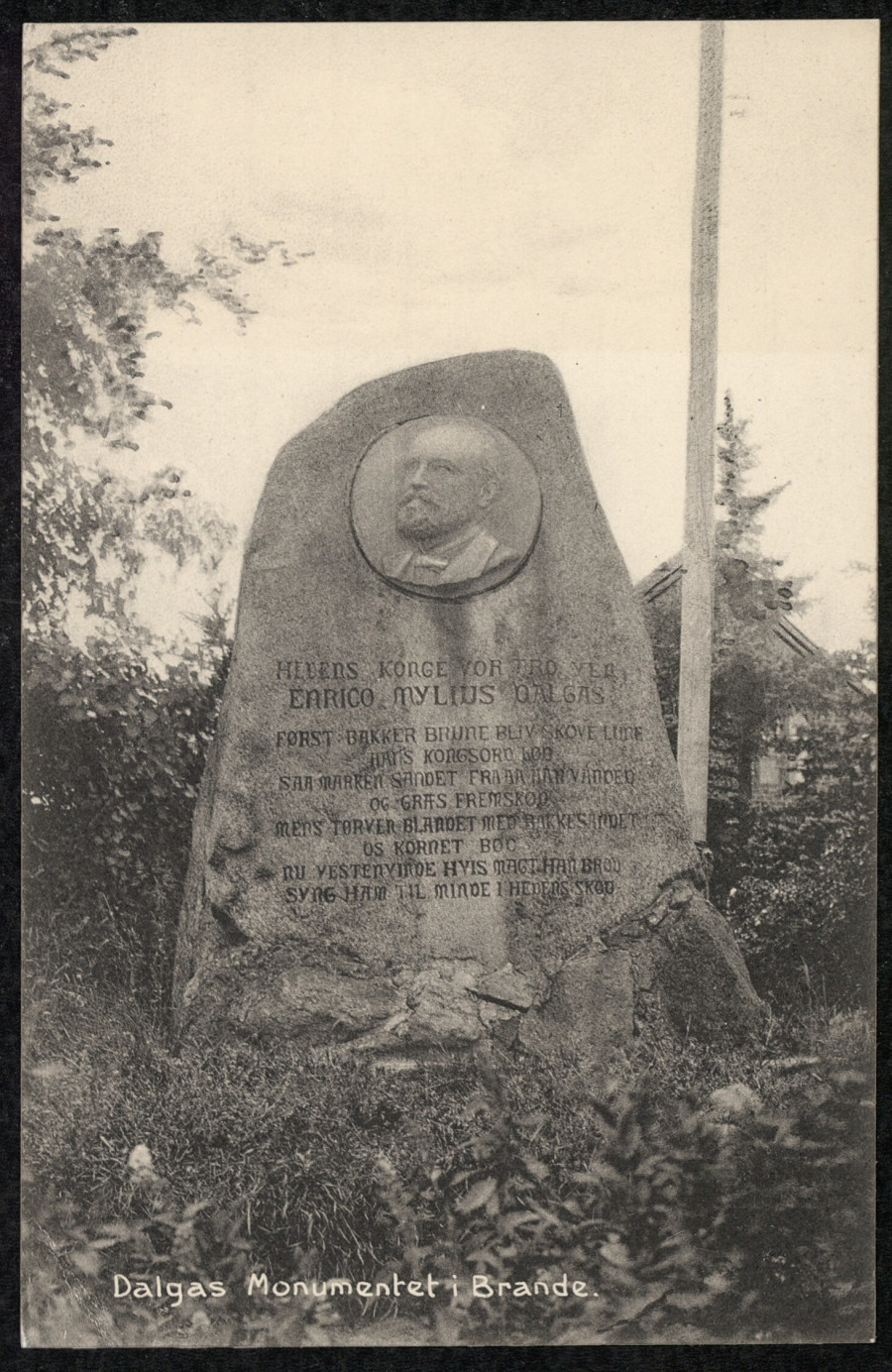
Monument in the Midwest Jutlandic town of Brande honouring Enrico Dalgas with the inscription: “King of the heathlands, our faith in Enrico Mylius Dalgas. First, brown hills become warm forests, his command sounded. Sow the sandy field, from the creek he watered, and grass sprouted forth. While peat mixed with hill sand offered us wheat, now the western wind, whose power he broke, sings to his memory in the heathlands’ womb,” (my translation from the Danish). Royal Danish Library, the Digital Image Collection, image id: KE021415.tif. http://www5.kb.dk/images/billed/2010/okt/billeder/object268321/en/ (accessed November 8, 2024). (Photo: © J. Christensen and the Royal Danish Library.)
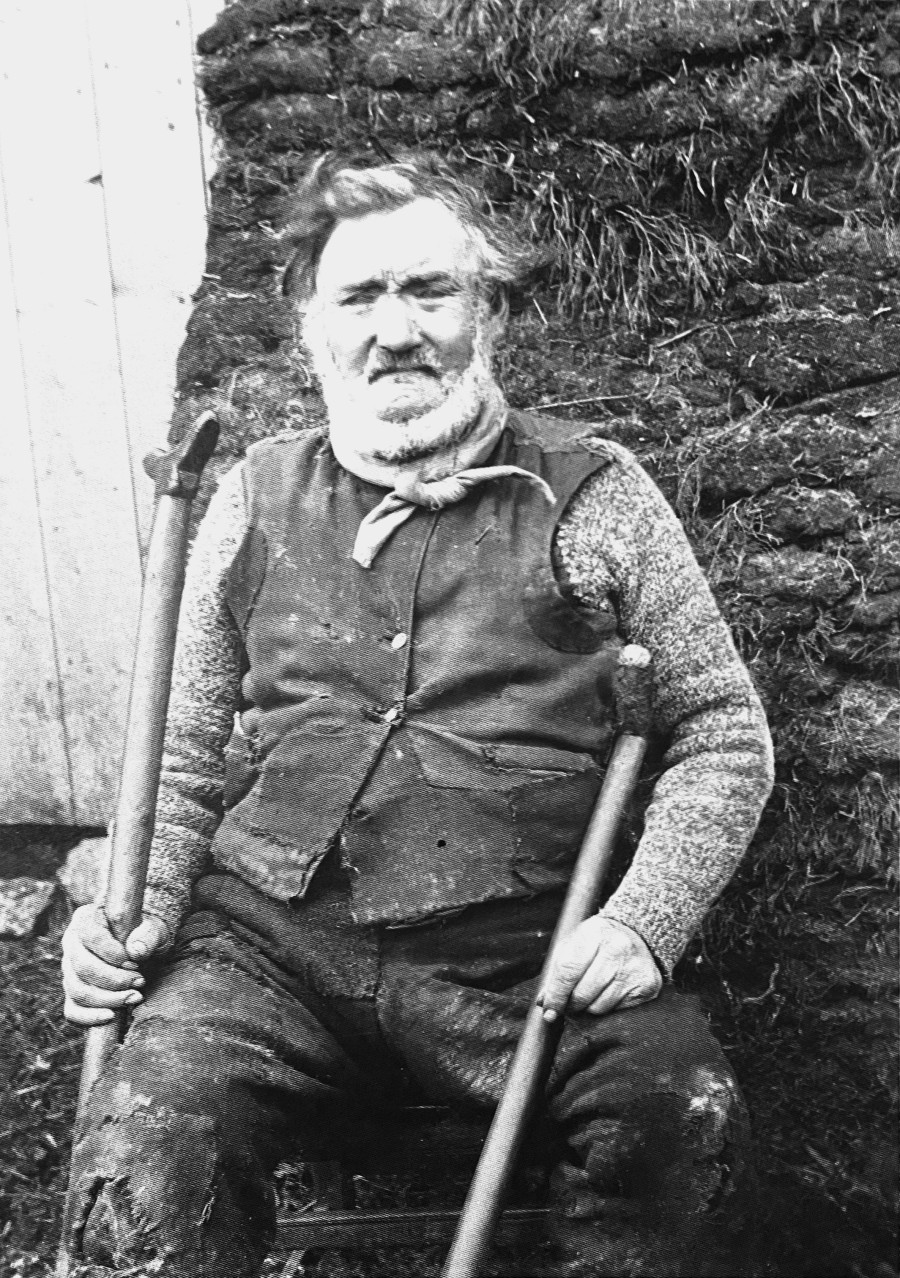
Jesper Pedersen, also known as Jesper Skrædder or Jesper Talund, was – along with my great-great-great-great-grandmother Johanne Tygesdatter – one of Evald Tang Kristensen’s two 1873-informants in Sammelsted By. Originally trained as a tailor, he turned out incapable of making a living during the turbulent 1800s and wound up in Sammelsted By with his wife. Contrary to Tygesdatter, who had died by the time Tang Kristensen returned with photographer Peder Olsen in 1895, Pedersen had his portrait taken for Tang Kristensen’s 1927-picture book Gamle Kildevæld. Nogle Billeder af Visesangere og Eventyrfortællere. The photograph is reproduced in: Evald Tang Kristensen, Peder Olsen, and Erik Høvring Pedersen (ed.): Gamle Kildevæld (Copenhagen: Nyt Nordisk Forlag Arnold Busck, 1981) (1927), 48. (Photo: © Peder Olsen.)
Consequently, many fell under the Poor Law authorities and were relegated to poorhouse facilities such as Sammelsted By. Tang Kristensen visited this settlement in 1873, following “that same desolate stretch where Steen Steensen Blicher had set the scene for his short story ‘Kjeltringliv’” (my translation).
( 57 )
Tang Kristensen 1876, 338.
Tang Kristensen writes: “I was walking as if blindfolded, knew neither road nor path and could see neither anyway.”
( 58 )
Tang Kristensen 1876, 338.
Eventually, however, he arrived at the settlement, where he encountered my great-great-great-great-grandmother, Johanne Tygesdatter, from whom he recorded thirteen songs – one of which had never been transcribed anywhere before.
( 59 )
In De Forsvundne, the folklorist Palle Ove Christiansen writes that Evald Tang Kristensen later, in 1874, recorded the song from yet another informant, Jens Talund, and that the latter added two more verses to the song. See Palle Ove Christiansen, “Insidder Johanne Tygesdatter. Sammelsted fattigkoloni,” in De Forsvundne (2011), 134 and 136). Consulting Evald Tang Kristensen’s handwritten notes and letters in the Danish Folklore Collection at the Royal Danish Library in Copenhagen, Tang Kristensen attributes the verses to Johanne. He writes: “Later she remembered these two end verses // 19. There is no Maiden on this Land / which may keep her Husband like she can // 20. There is no Man on this Island / who has such a cunning Spouse” (my translation). See Evald Tang Kristensen, “Johanne Tygesdatter i Sammelsted By, Ørre” in Visemanuskript II (Folkeviser optegnede i Jylland (Tang Kristensen 1929, 535). In the printed version of his song collection, published in 1876, Tang Kristensen attributes the song in its entirety, including the two end verses, to Johanne Tygesdatter. See Evald Tang Kristensen, “Forvandlingen” (Tang Kristensen 1876, 1).
Tang Kristensen entitled the song “Forvandlingen” (The Transformation). It is worth dwelling on because it introduces important new figures into an otherwise well-known Nordic mythological cast. It tells of an enchanted landscape of burial mounds shrouded in drifting dew and falling frost, where “elver-dwarves” (little people) are dancing. Here, Daughter Donnimaar is dancing with the lovely Knight of the Rose Garden, whom she suggests transforming into, first, a pair of shoes for her to wear on her little feet; then a pair of gloves for her to wear on her slender hands; and, ultimately, a golden flax thread. The knight politely rejects her two first proposals, saying: “I do want to carry your gifts, but I don’t want to be a pair of shoes,” or “I don’t want to be a pair of gloves.” But when she suggests turning him into the golden flax thread and braiding him into her hair by her rosy cheek, he accepts, and together they venture off to her father’s farm.
The father greets them by the gate, saying: “Welcome, Daughter Donnimaar, and so lovely a Knight of the Rose Garden!” The father has, in other words, seen through the deceit and their attempt to hide the knight by braiding him into her hair. Daughter Donnimaar then opens her blue cape and says: “Yes, dear father, that’s what you’re looking at!” But the father is not fooled. Rightly, he says that the knight is not under her cape, but braided into her hair – and not by her scarlet cheek, but by her rosy cheek. Then he brings forth a sharp knife to cut her hair into seven pieces.
( 60 )
The original word in the Danish/Jutlandic lyrics is “stykker”/“stø’ker,” which in the context of hair sounds equally awkward as the English ‘pieces.’ I have however decided to keep ‘pieces’ in the text above for accuracy.
He cuts her hair into nine pieces, but the Knight of the Rose Garden escapes. The song then ends:
There is no Maid in this Land
Who may keep her Husband like she can.
There is no Man on this Island
Who has such a cunning Spouse (my translation).
In the printed version of Evald Tang Kristensen’s song collection, published in 1876, three years after Tang Kristensen’s encounter with Johanne, he introduces the song thus:
This highly strange old Magic Song has so far only been found in the Memory of one single old Woman in Sammelsted By, Ørre Parish. No other old or new Recording of it is known, neither from Denmark nor other Countries (my translation). ( 61 )
Tang Kristensen 1876, 1. Tang Kristensen seems to be writing against his own better knowledge, however, since after recording the song from Johanne in 1873, he recorded the song from another singer, Jens Talund, in 1874, and thus before publishing his findings in Gamle Jyske Folkeviser in 1876. See also Evald Tang Kristensen, “Der gaar Dands ved Bjærge” in Visemanuskript II (1929, 684).
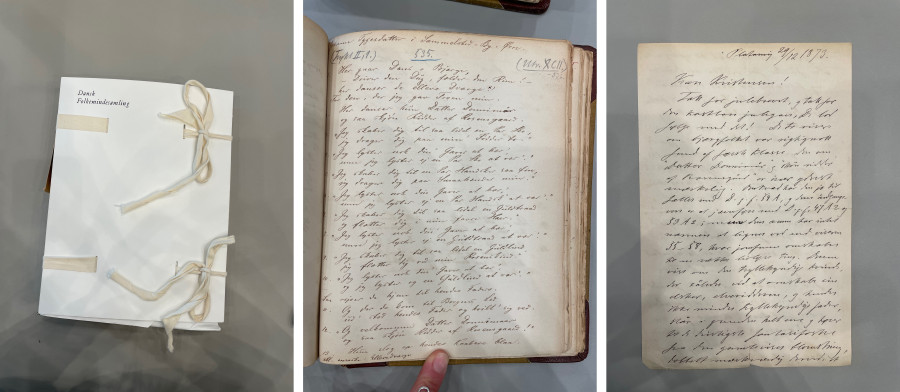
Excerpts from Evald Tang Kristensen’s handwritten notes describing his encounter with my great-great-great-grandmother Johanne Tygesdatter in 1873, and his subsequent correspondence with the literary historian and ethnographer Svend Grundtvig. The Royal Danish Library, Danish Folklore Collection. (Photo: © Marie Kølbæk Iversen.)
This assessment was echoed by Svend Grundtvig, the Copenhagen-based literary historian and ethnographer for whom Tang Kristensen was working.
( 62 )
Svend Grundtvig was the son of Nikolai Frederik Severin Grundtvig, founder of the Danish folk high school movement (Højskolebevægelsen); he had inherited his father’s keen interest in folklore.
In a personal letter, Grundtvig congratulates Tang Kristensen on this “first-class find,” adding that the song is “truly strange” and encouraging him to “squeeze as much as possible out of this Johanne” (my translation).
( 63 )
Svend Grundtvig to Evald Tang Kristensen: 1929 / 144 II. [correspondence], Dansk Folkemindesamling 29 December 1873; 18 December 1874.
Grundtvig compares the song’s many transformations to those of another song, in which a maiden is transformed into a succession of different lifeless things.
( 64 )
Svend Grundtvig: “Jomfruen i Ulveham,” (DgF 55), “Jomfruen i Fugleham,” (DgF 56), “Nattergalen,” (DgF 57), and “Jomfruen i Hindeham,” (DgF 58) in Grundtvig 1824–1883.
But the strange culmination of “Forvandlingen,” with the father cutting off Daughter Donnimaar’s enchanted hair, passes unmentioned by both Grundtvig and Tang Kristensen.
Possibly neither Tang Kristensen nor Grundtvig had read the collected tales of the German brothers Grimm, or possibly neither wanted – whether for national or political reasons – to emphasize the resemblance of the motif of little people and enchanted hair being cut off to recurring motifs across German folktales such as “Rapunzel,” “Rumpelstiltskin,” and, in particular, “The Gifts of the Little People.”
( 65 )
Jacob and Wilhelm Grimm: “Rapunzel” and “Rumpelstiltskin” in Kinder- und Hausmärchen, vol. 1 (Grimm 1812); “The Gifts of the Little People” (Die Geschenke des kleinen Volkes) in vol 6 (Grimm 1850); Brothers Grimm: “De Små Folks Gaver” in Samlede Eventyr (Grimm 2006, 471–72).
In “The Gifts of the Little People” two travellers, a tailor and a goldsmith, are lured into a circle of little people dancing and singing by a mound. In the middle of the circle an older and slightly taller man is standing, and he motions both to step forward. The circle closes around them, and the little people begin singing and dancing wildly. Then, suddenly, the old man takes a knife hanging from his belt, sharpens it, and grabs hold of the goldsmith. With great speed he smoothly shaves off his beard and the hair from his head. Then, the same thing happens to the tailor. Their fear disappears when the old man pats them in friendly manner on the shoulder as if wanting to say that they had done well by letting it all happen without resisting. As a reward for their docility, he urges them both to fill their pockets with coal lying in a stack. After a good night’s sleep at a nearby tavern, the coal is transformed into gold.
( 66 )
“Rumpelstiltskin” (Grimm 1812).
Transformations agreeably abound. But if we diverge from Grundtvig and, rather than focusing on transformations into or between lifeless things, take note of the fact that the tale’s protagonists are indeed travellers, then the echo of a cultural resonance emerges between the German folktale, the wedding ceremony, and Johanne’s song from Ørre Heath. On the one hand, the tale and the song share the motif of the little people dancing on mounds, with an older male representative, or father, cutting off the protagonists’ hair, to their subsequent gain. On the other hand, the ceremony overlaps both with the German folktale (by placing the father at the centre of the circle, the centre of mytho-ritualist action) and with the song (by pitting the naturalized power of the father against the energetic life force and desire of the young suitor seeking to unite with his daughter, Kjæltring Katrin or Daughter Donnimaar, respectively, in love). And while “The Gifts of the Little People” dramatizes travelling life, the song “Forvandlingen” was recorded in a travelling community some 600 kilometres further north of the Brothers Grimm’s base in Kassel.
Certainly, none of this amounts to scientific proof of a national connection. Yet, a structuralist perspective on such overlapping figures or “mythemes” may nonetheless suggest a larger degree of cultural exchange and mythic continuity between west Jutland and what would subsequently become Germany than that fitting the Danish national liberalists’ narrative of a unified and homogenous Danish nation marked out against Germany (which both Grundtvig and Tang Kristensen were working to substantiate with their collections).
( 67 )
“In structuralist anthropology and literary criticism, [the mytheme is] each of a set of fundamental generic units of narrative structure (typically involving a relationship between a character, an event, and a theme) from which myths are thought to be constructed.” See “Mytheme,” Oxford Dictionaries English 2022.
Possibly it was precisely because of the many historical and mythemic overlaps between west Jutland and northern Germany that nationalists on both sides were seeking to emphasize and extrapolate the differences between the nations, by muting those populations and parts of society that had traditionally supported transcultural common(s) and travelling motifs in their storytelling and ways of life.
The Mytho-Politics of Nothing
For the anthropologist Claude Lévi-Strauss – whose study of mythology in the Americas has reintroduced history as an integral aspect of the mythological realm – mythic thinking is characterized by functioning as a “shock absorber for the disturbances caused by real life events,” ensuring cultural continuity against historical developments.
( 68 )
Lévi-Strauss 1990, 607, and Gow 2001, 10–11.
Following Lévi-Strauss’s “Structural Study of Myth,” myths are organized in what he calls “transformation groups,” each consisting of a set of isomorphic variations of the same mythological motif – the same “mytheme” – of which none can be said to be more true or archaic than any of the others.
( 69 )
Lévi-Strauss, “The structural study of myth” (1955), 439, and Lévi-Strauss 1971, 27.
Together, these mythical variations attest to the contingent and differential quality of Being through a structure of transformation, understanding “difference as disequilibrium and dissymmetry, but not opposition.”
( 70 )
Peter Skafish: “Introduction” in Eduardo Viveiros de Castro, Cannibal Metaphysics (2014), 22).
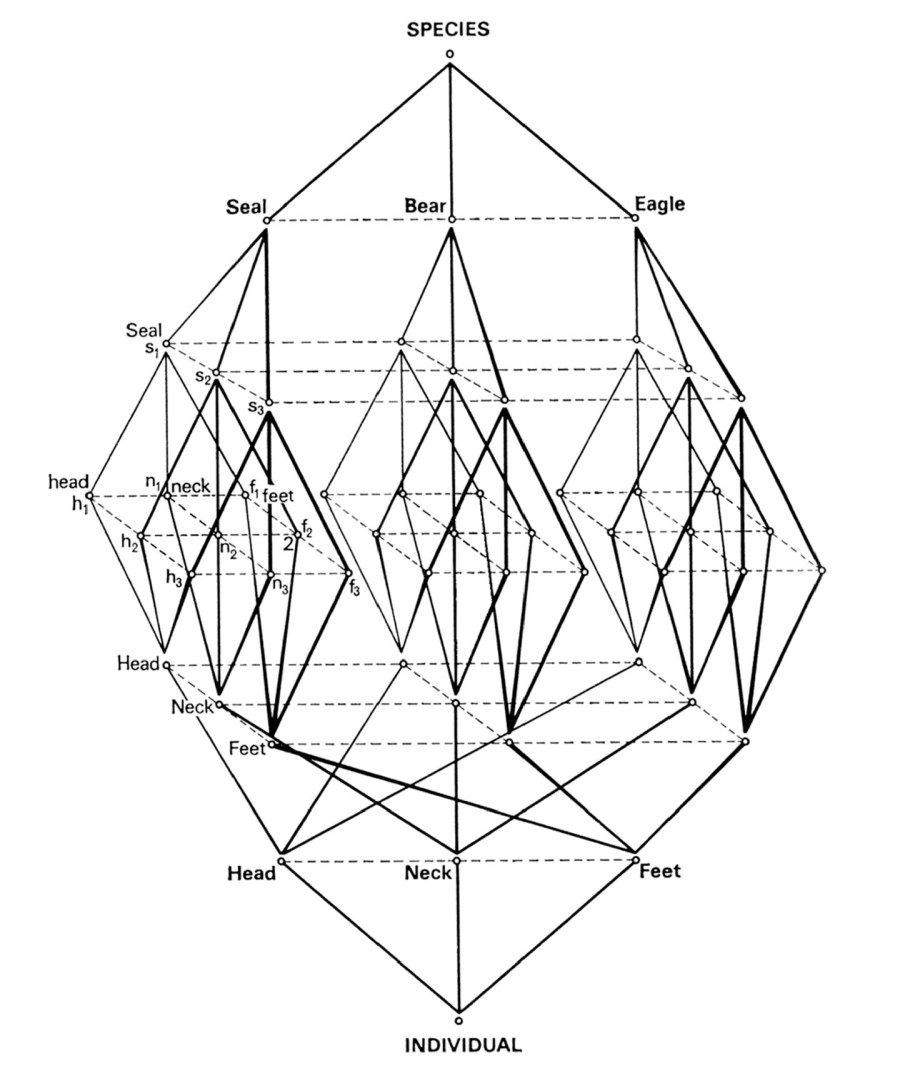
According to Lévi-Strauss, the “logics governing the life and thought of so-called primitive societies are shaped by the insistence on differentiation. The latter is already evident in the myths[.]” Lévi-Strauss 1966, 75 and 152 (diagram).
Thus, even if the aim of mythic thinking, according to Lévi-Strauss, is the obliteration of history – manifesting in a community as cultural change – myths are in no way to be considered ahistorical. On the contrary, “we can look to the very myths themselves to tell us what historical events and processes they might be seeking to obliterate.”
( 71 )
Gow 2001, 12.
This is because in the myth’s sheer insistence on being told, or the teller’s insistence on telling it (even if in altered form, and even on invitation), we see the wish arising from within the myth, originating in the vast network of “contemplating minds” that conceived it, to obliterate the pressuring forces that inspired its alterations.
( 72 )
Lévi-Strauss 1990, 10.
Similarly, when a myth ceases to be told – as was the case with the mythical triangulation of Johanne’s song with the German folktale and the wedding ceremony – this may equally suggest a strong and sudden cultural upheaval. This is because it follows from the Lévi-Straussian approach that mythical narrative is, at its core, a strong political and ethical engagement that is congruent not only with historical pasts, but also historical presents and futures, linking them together. It is an engagement that is tightly interwoven with the wish to live and persist, that is, with a will to futurity. This also means that any one rendition of h/History – with and without a capital H – will always be a construction, an event in constant motion that depends on the perspective of its narrators.
( 73 )
I borrow the term “event in constant motion” from the psychologist Rafael Barroso Mendonça Costa, who unpacks Amazonian shamanism as a cosmopolitical practice in the contemporary: Costa, “Ayahuasca: uma cosmoprática xamânica” (2016) at 00:46:14–01:01:46.
We can thus only speculate as to the reason why – despite its “first-class character” as per Svend Grundtvig – Johanne’s song “Forvandlingen” did not make the cut into the popular selections of old Danish ballads that became one of the most influential outcomes of Golden Age folklore collection, providing the basis for mandatory teaching about folksongs and ballads in Danish schools up until today.
( 74 )
Ernst Frandsen (ed.), Danske Folkeviser (Frandsen 1966–71). As stated on the back cover, Danske Folkeviser [Danish Folksongs] “offers a beautiful, precise, and justified selection of what could rightly be called the breeding ground for Danish poetry” (my translation). See also Bekendtgørelse 2020.
While Blicher, Grundtvig, and Tang Kristensen all passed into canonized literary history, the west Jutlandic travellers passed into oblivion. This enables us to contemplate how the writing of history is far from neutral, but actively produces white spots in the landscape – “nothing” – which in turn lock in wordless unutterability that which majoritarian culture cannot or does not want to include, such as its own negation or proof of its constructedness.
Another “We”
Acknowledging the fictional character of national Danish mythology by tracing its wilful omissions may, then, be the first step towards cracking open the imposed vacuum that continually exhausts the heathlands and mutes their mythologies as they narrate their cultural continuities beyond the realm of Denmark. To challenge these dynamics, I have worked since 2017 with the songs that Evald Tang Kristensen collected in the 1870s from my great-great-great-great-grandmother Johanne Tygesdatter and her peers in and around Ørre, and in 2021 I launched my first album under the artist’s name Donnimaar. On the album entitled Vredens Børn, I had invited linguist Michael Ejstrup to reinterpret Tang Kristensen’s recordings from Standard Danish into Ørre Jutlandic, attempting to approximate how it might have been spoken or sung at the time of the songs’ transcription in 1873.
( 75 )
Marie Kølbæk Iversen, Donnimaar. Vredens Børn 2022.
Of course, changing the material in this way is not an uncontroversial thing to do, particularly not for an academic researcher, who might be expected to stay true to historical sources. But in this regard, I am primarily an artist. And I would argue that truth is not a surface structure phenomenon, and that fidelity to historical sources can sometimes require engaging at other levels than wording precision.
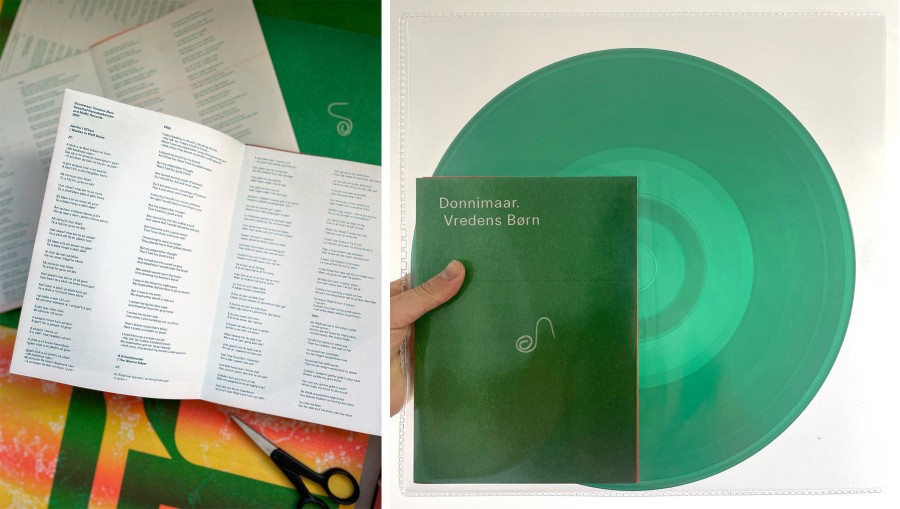
Marie Kølbæk Iversen: Donnimaar. Vredens Børn [music album] (Copenhagen: MoBC records, 2021–22). (Photos: © Marie Kølbæk Iversen, 2021)
Like myths, vernacular songs change with the singer and the historical context.
( 76 )
Lene Halskov Hansen: “Ord og billeder” in Balladesang og kædedans (L. H. Hansen 2015, 108–9).
I thus felt I was staying “truer” to the songs of my foremother by engaging with them in a transformative and historically dependent mode than by sticking to the precise wording of what – by a random historical coincidence – ended up being the last time they were recorded by a folklorist. Indeed, the world has changed profoundly since the 1870s, and for the songs to have any kind of relevance as something other than mere curiosities of the archive, I felt I had to engage with them from my historically contingent positioning too. In so doing, I also meant to challenge the presumed objectivity that detaches the researcher from their material. In my view, such objectivity is rarely the neutral gesture it pretends to be; on the contrary, the ambition of the mythographer to detach themselves from the myth they are analysing could be seen as an active contribution to the project of definitively fixing such myths – and the cultures they seek to perpetuate – in distant pasts or different worlds. But as I see it, the mythographer engaged in doing so is not not mythologizing; rather, they are perpetuating the countermyth that the dissidence of these myths and cultures has already been overcome – that “they” have vanished, and “we” won; that “they” have nothing to do with “us.’
But suppose “they” are not in the past? Suppose the heathland storytellers are no more “vanished into nothingness,” as the title of Palle Ove Christiansen’s book, De Forsvundne (The Vanished) suggests, than everyone else who has died since the 1870s.
( 77 )
Christiansen 2011.
Or suppose I may at least keep their culture from vanishing entirely by actively engaging with Johanne’s songs, by making them mine, now – voicing their words in a dialect which could also have been mine, had the centralized Danish school legislation not had as its stated mission to homogenize Denmark by eliminating all dialects.
( 78 )
Bue Rübner Hansen: “Den Sorte Jyde” (B. R. Hansen 2017).
In linguistic circles, a language is said to be nothing but a dialect, albeit with an army and a navy.
( 79 )
Mikkel Wallentin, “Vi udvikler os med sproget” (Wallentin 2016).
And you could add, with a broadcasting corporation and a school system, too. At any rate, the feat of eliminating the dialects was – until 1967, when the schoolteachers’ right to corporally punish students was abolished – not least carried out through physical violence in our parents’ schools.
( 80 )
Ole Varming, “Revselsesret” 1997.
Thus singing in dialect is intended as an invitation to remember the difference that existed – perhaps still exists – between the different Danish regions. Not to “lie the Distance between Jutland and the Isles larger than it is,” as Jeppe Aakjær puts it, but neither, as he also states, to “pretend that the Fusion Politics has already succeeded in laying out a Footbridge between us and them; because Distance there is, and national Difference too” (my translation).
( 81 )
Jeppe Aakjær, “Fortale,” in Jydsk Stævne (Aakjær 1902, unnumbered page).
Singing in Ørre Jutlandic dialect, then, however badly pronounced, is a means of estranging myself from my homogenized Danish state. Not to claim a Jutlandic nationality instead, as Aakjær possibly would, but to experiment with singing from a position that irritates the very notion of Danishness.
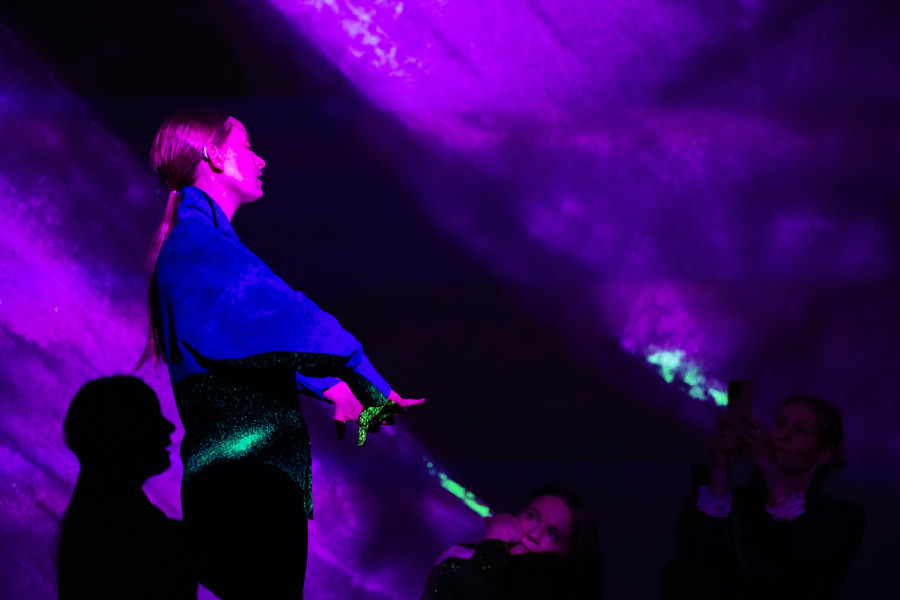
Marie Kølbæk Iversen: Donnimaar [performance] inside Marie Kølbæk Iversen, Rovhistorier | Histories of Predation [video installation] in “The Atlantic Ocean,” 2024, group exhibition at Henie Onstad Art Centre, Høvikodden, Norway. (Photo: © Nabeeh Samaan and Henie Onstad Art Centre.)

Marie Kølbæk Iversen: Donnimaar [performance] in “Rovhistorier,” 2022, solo exhibition at O – Overgaden, Copenhagen, Denmark. (Photo: © Christian Brems and O – Overgaden.)
Since national history will always have a specific geographical centre, its rendition of national identity cannot resonate in the same way across the country: Beech trees and shallow sounds may find themselves distorting, with changing land- and seascapes, as they move from the centre towards the peripheries; noble saviours may be “antiphased” or fail to resonate altogether.
( 82 )
Antiphase sound (…) cancels unwanted noise.” See “Antiphase,” Merriam-Webster – English 2024.
Thus, reviving mythic views from alternative centres, un- or differently resonant centres – along with decentralized and itinerant forms of knowledge – is a way for me of insisting on the heterogeneity and malleability of identity that persists beyond the exclusionary nationalist freeze frame of selected perspectives on our shared past. It is a way of insisting that if “traveller” is just as much something one does, as something one is, then I may echo – that is, resume resonating with – the suppressed trans-cultural itinerance of my “heathen” west Jutlandic background by singing Johanne’s songs; addressing and empowering another “we” than the “we” that sees itself demarcated through Danish and Danifying national mythology.
( 83 )
“Traveller” is likely both something one does and something one is – a practice-based identity, which over the course of centuries sediments into genetics. Recent research has shown an established genetic difference between the Irish Travellers and the settled Irish, from which the Travellers likely diverged in the seventeenth century: Gilbert et al., “Genomic insights into the population structure and history of the Irish Travellers” (2017).
Aakjær, J. (1902). Jydsk stævne. Aarhus: Det Jydske Forlag.
- Oelsner 2021, 146–47. ↑